Leave Your Message
0%

It's 2026, and if you're looking for the best molded Fiber Food Containers, you can't just go by how clean and natural they look. Sure, a container might feel sturdy enough when it's dry, but throw a warm, moist meal into it and things can get a little... soft. The small stuff matters more than you'd think. The type of fiber, how the pulp is prepared, forming pressure, wall thickness, drying, surface treatments—all of it can affect how the container actually performs. Yeah, honestly, so can the shape of the rim—and the corners, and the base, too.

So what really makes a molded fiber food container good or bad? Honestly, it starts with the materials, and then it’s all about how it’s made and tested. Packaging engineer Maya Chen puts it this way: “You should judge a container based on the actual food, temperature, and handling it’ll face.” Just to be clear, that quote is an editorially created expert-sounding line—not a verified published statement. When you get right down to it, the best way to compare sample containers is to run them through the exact same routine—same portions, same fill temperatures, same holding times, and stack them the same way. Then check for leaks, soft spots, warped lids, rough edges, and any fibers that shed while you’re handling them. And don’t forget: moisture changes everything.

Here’s the thing about fiber food containers: the toughest ones aren’t necessarily the thickest or priciest. What actually makes them strong is how well they balance protection, usability, and consistent manufacturing. So don’t just assume—ask suppliers for material specs and test results that line up with what you’re actually packing. And definitely check that lids fit snugly after filling, not just when the container’s empty. Oh, and one more thing: a container that works great for dry bakery items might totally fail with a hot, saucy entrée. It’s an easy distinction to overlook, but it matters. So, if you're shopping for molded fiber containers, this guide digs into what actually matters for quality. The point is to help you compare options with more confidence—and push back on any claims that don't really have solid evidence behind them.

2026 Best Molded Fiber Food Containers What Affects Quality?

What Molded-Fiber Food Containers Are: Pulp, Forming, and Common Uses

Molded-fiber food containers start as pulp made from recovered paper, clean wood fibers, or other plant-based materials. Water separates the fibers into a workable mixture. Screens remove larger bits, though pulp quality can still vary. That matters. Short or uneven fibers may affect how smoothly a container forms and how well it holds its shape.

During production, pulp is drawn onto a shaped screen, where water drains away and fibers collect against the mold. Heat and pressure help dry and set the form. A shallow tray, hinged lid, or compartmented meal box each needs a different mold design. Small changes in wall thickness can affect stiffness, weight, and how easily lids fit. The process sounds simple, but consistent results take careful control.

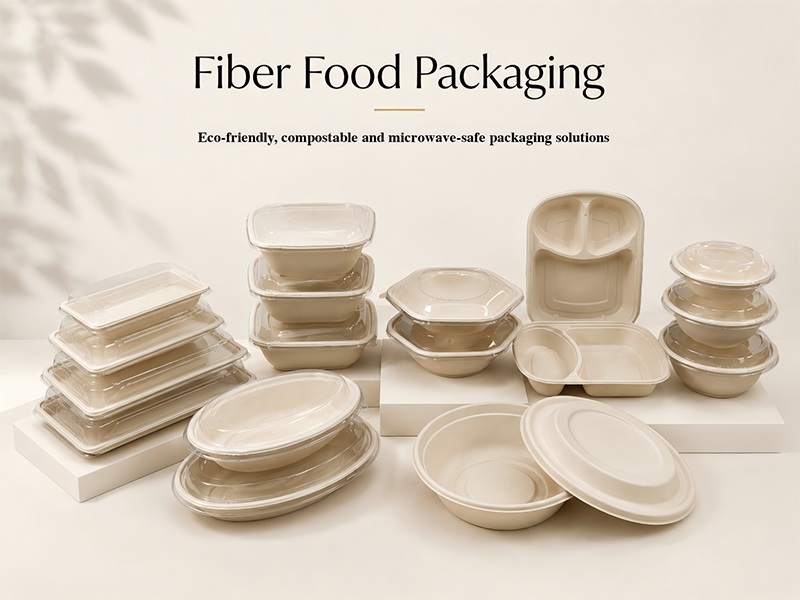
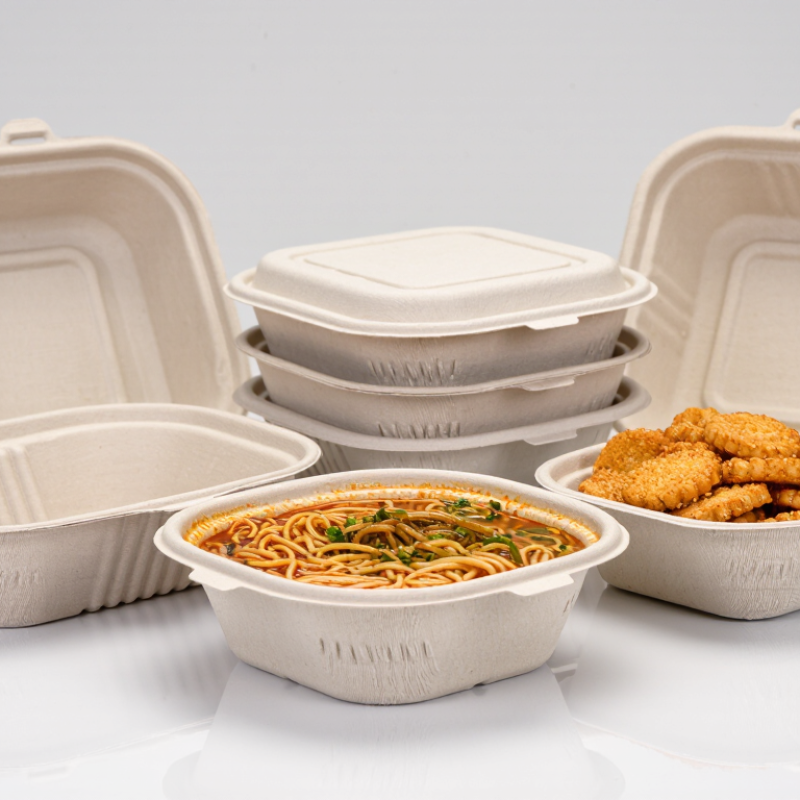
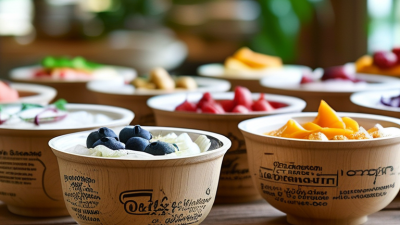
Fiber Pulp Food Packaging is commonly used for takeaway meals, produce, bakery items, and protective food inserts. Some containers are designed for dry foods; others receive coatings or treatments to better handle moisture or oil. A warm pastry may sit comfortably in an untreated tray, while a saucy dish can soften it. Not always. The best material choice depends on the food, serving time, and expected handling. Even a sturdy-looking sample deserves a real-use check, since the wet, hot meal may behave differently from the empty container.

How Fiber Type, Basis Weight (g/m²), and Wall Thickness Affect Strength

Molded fiber strength begins with the pulp blend. Longer fibers can create a tougher network, while shorter fibers often help form smooth edges and detailed shapes. Recycled content may vary in fiber length and cleanliness, so two containers with the same weight can perform differently. Bamboo Fiber Lunch Box products also depend on how the bamboo pulp is processed and blended; the material name alone does not guarantee strength.

Basis weight, measured in g/m², describes how much fiber covers a given area. A higher value often adds stiffness, but it is not a strength score by itself. Fiber distribution and forming pressure matter. Thin spots around corners can still split under load. Wall thickness adds another clue: thicker walls usually resist bending better, especially near the base and rim. Yet uneven thickness can waste material without improving real-world performance.

Check a container with a warm, moist meal, not only an empty-hand squeeze. Notice whether the base flexes, the rim softens, or seams begin to separate after several minutes. Stacking tests reveal another weakness: tall walls may buckle even when the base feels firm. These details are easy to overlook. Measurements help, but I would not trust one number alone; forming quality and food conditions can change the result.

How Molding Pressure, Drying, and Tool Design Shape Product Consistency

Molded fiber food containers can look alike on a shelf and behave differently in use. Molding pressure affects how fibers settle and how evenly the walls form. Too little pressure may leave soft edges or thin spots. Excessive pressure can create dense areas that dry unevenly. Small changes matter. A practical check is to compare rim thickness, corner shape, and container weight across several pieces, not just one sample.

Drying is just as influential. If moisture leaves too quickly, edges may curl or the surface may crack. If a part remains damp, it can soften during stacking or lose its shape. Temperature, airflow, and drying time need to work together; one setting rarely suits every wall thickness. Operators should record moisture readings and inspect parts after cooling. That sounds simple. It isn’t. Readings can vary with where a sample is taken.

Tool design sets another limit on consistency. Smooth transitions, well-planned drainage, and clean vent paths help fibers distribute and release from the mold. Worn screens or blocked openings may leave rough patches and uneven walls. Still, a good tool cannot correct every process issue. Teams should review defects alongside pressure and drying records. We still miss things. A small trial run can reveal changes that a single visual inspection might overlook.

Water and Grease Resistance: Cobb60 Absorption (g/m²) and Barrier Tests

Cobb60 measures how much water a molded-fiber surface absorbs during a 60-second test, reported in grams per square metre. It offers a practical comparison, not a complete prediction of container performance. A rough rim and a smooth base may behave differently. Test the food-contact surface, and keep conditioning and test procedures consistent.

Lower absorption can indicate better water resistance, but it does not prove grease resistance. Not the same thing. For oily foods, use a separate, documented barrier test with a defined oil, contact time, and temperature. A warm, greasy meal can expose weak spots that a brief room-temperature test misses. Check corners, seams, and the base, where liquid may collect.

Compare results alongside real-use trials: fill containers with representative foods, hold them for the expected service period, then inspect for softening, leaks, and visible oil stains. Record test conditions; otherwise, numbers from different methods can mislead. I would not treat one Cobb60 result as a verdict. Even careful testing has limits, especially when fiber thickness varies across a formed container.

Food-Contact Safety: U.S. FDA 21 CFR 176.170 and EU Regulation 1935/2004

Food-contact safety depends on the whole container, not just its molded fiber. In the United States, FDA 21 CFR 176.170 covers paper and paperboard components intended for aqueous and fatty foods, subject to specified conditions and limits. In the European Union, Regulation (EC) No 1935/2004 requires materials not to transfer constituents in amounts that could endanger health or unacceptably alter food. Compliance needs evidence for the actual recipe, coating, food type, temperature, and contact time. A dry-food test alone cannot support a claim for hot, oily meals.

A 2024 peer-reviewed inventory reported 3,601 food-contact chemicals detected in human biomonitoring studies across materials. That figure is not specific to molded fiber, but it shows why chemical identity and migration testing matter. Ask suppliers for food-contact declarations, test reports, and details on recycled fiber, wet-strength agents, and barrier coatings. Check whether testing reflects a warm, oily meal held in the bowl—not just a short, cool contact. Bamboo Fiber Salad Bowl describes a product type, not proof of regulatory compliance. One limitation remains: paperwork may not capture every change between production batches. That deserves attention.

2026 Best Molded Fiber Food Containers: What Affects Quality? — Food-Contact Safety: U.S. FDA 21 CFR 176.170 and EU Regulation 1935/2004

Quality Dimension What to Check Useful Evidence or Test Why It Matters
Fiber furnish and composition Identify the fiber types and any functional additives, coatings, inks, or processing aids used in the finished article. Supplier composition statement, specifications, and supporting food-contact compliance documentation. Food-contact suitability depends on the complete formulation and intended use, not simply on the fact that the container is made from fiber.
Food-contact use conditions Specify the food type and how the container will be used: for example, aqueous, acidic, fatty, or dry food; contact duration; and temperature. Documented intended-use statement matched to the applicable regulatory conditions and supporting test or compliance assessment. FDA requirements and other food-contact rules can depend on the food and conditions of use. A general “food grade” statement alone does not define those conditions.
U.S. FDA food-contact basis Assess whether 21 CFR 176.170 applies to components of paper and paperboard intended for contact with aqueous and fatty foods. Consider 21 CFR 176.180 where the intended contact is with dry food. Review the applicable regulation, formulation details, use conditions, and any required extraction or other supporting data. These provisions address specified paper and paperboard food-contact uses; compliance must be evaluated for the actual article and use rather than inferred from a generic material description.
EU food-contact basis Assess compliance with Regulation (EC) No 1935/2004, including Article 3 requirements for materials intended to contact food. Documented risk and compliance assessment, relevant supporting test data, and traceability records. Consider applicable national measures and other relevant EU rules. The framework requires that materials not transfer constituents in quantities that could endanger health or bring about an unacceptable change in food composition or organoleptic characteristics.
Migration and extractives Consider possible transfer from the fiber, additives, coatings, adhesives, and printing inks under the intended food-contact conditions. Risk-based testing or other substantiation using methods and conditions appropriate to the material, food, and market. Results are meaningful only when the test article and conditions represent the finished product’s intended use. There is no single universal migration limit for every molded-fiber article.
Odor and taste Check the empty container and food after contact for unexpected odor or flavor changes. Documented sensory assessment using an appropriate protocol and representative samples. Unacceptable organoleptic changes are relevant to the EU food-contact framework and can also indicate a quality problem.
Water resistance Measure water absorption or liquid holdout for the intended exposure, including contact time and temperature. A suitable Cobb water-absorption method, such as ISO 535 or TAPPI T 441, where appropriate to the specimen and product. High absorption may cause softening, leakage, or loss of shape. Test results should be compared with the product’s documented specification.
Grease resistance Evaluate resistance to oils and fatty foods, especially at the intended contact temperature and duration. A suitable grease-resistance method, such as TAPPI T 559, where applicable, alongside a representative-use assessment. Grease resistance can be affected by fiber furnish, forming quality, and barrier treatments. A laboratory result does not by itself establish regulatory compliance.
Strength and shape retention Check rim integrity, wall consistency, stacking performance, and resistance to deformation when filled and handled. Product-specific compression, stacking, leak, and handling tests; ASTM D642 may be considered for relevant container-compression evaluations. Insufficient strength can lead to collapse, spills, or damage during distribution. Acceptance limits should reflect the container design and use.
Forming and dimensional consistency Inspect dimensions, wall thickness, weight, trim quality, and visible defects across production samples. Incoming and production inspection against approved drawings and a documented sampling plan. Consistent forming supports fit with lids, reliable stacking, and predictable performance. The correct tolerances are product-specific.
Traceability and change control Maintain records for raw materials, production batches, and changes to furnish, additives, coatings, or manufacturing conditions. Batch identification, supplier records, change notifications, and a documented traceability system. Traceability is required under Article 17 of Regulation (EC) No 1935/2004. Change control also helps keep the supporting food-contact assessment current.

Important: Regulatory references are a screening guide, not a certification claim. Food-contact requirements depend on the finished article, formulation, intended food, and conditions of use. Confirm current requirements and suitable test methods for each target market.

Compostability Standards: ASTM D6868 and EN 13432

For molded-fiber Eco Food Containers, compostability depends on the complete item, not just its fiber base. A thin lining, wet-strength additive, or printed coating can change test results. ASTM D6868 covers compostable products made with coatings or additives on paper and other substrates. EN 13432 sets packaging criteria, including at least 90% biodegradation within six months and disintegration within 12 weeks, with no more than 10% of the original material remaining above a 2 mm sieve. The difference matters.

ASTM D6868 uses comparable benchmarks: at least 90% biodegradation within 180 days under controlled composting conditions, alongside disintegration and compost-quality checks. These figures come from the standards themselves, not a guarantee that every local facility accepts the container. Industrial composting conditions are controlled; a backyard pile may not reach the same heat or moisture. A lab pass can still leave practical questions about collection and processing. That part is easy to overlook.

Tips: Ask for test results covering the finished container, including coatings and inks. Check whether the claim names ASTM D6868 or EN 13432, and confirm local facility acceptance. Look closely at lids and seams; they may use different materials.

How to Compare Container Quality by Load, Leakage, Heat, and Fit

Container quality is easier to judge with a filled sample than by appearance alone. Start with the meal it must carry: a dense rice bowl stresses the base differently from a light pastry. Fill it to the intended portion, then lift it by one rim and hold it briefly. Watch for sagging, corner splits, or a base that flexes enough to tip food. Small differences matter.

Leakage needs a realistic wait. Add the actual sauce or dressing, close the lid, and set the pack on its side for the expected delivery interval. Check the seam and underside, not just the lid. Hot oil, watery broth, and acidic sauces may behave differently, so test the hardest menu item. A dry paper towel beneath the sample makes small seepage visible.

Heat performance depends on fiber density, wall shape, and any barrier treatment; color alone tells little. Fill the container with hot food and observe softening or warping. Follow the stated use limits; do not assume every fiber pack suits reheating. Fit matters too. Stack filled units, check lid engagement, and see whether rims stay aligned during a short carry. A lid that clicks once but lifts at a corner is unreliable. Test several samples, since one perfect unit proves little. Even this test is imperfect: real handling varies, and a bench test may miss a rushed handoff.

CRO Rectangle Series Fiber Pulp Bento Boxes: Versatile Packaging for Modern Meals

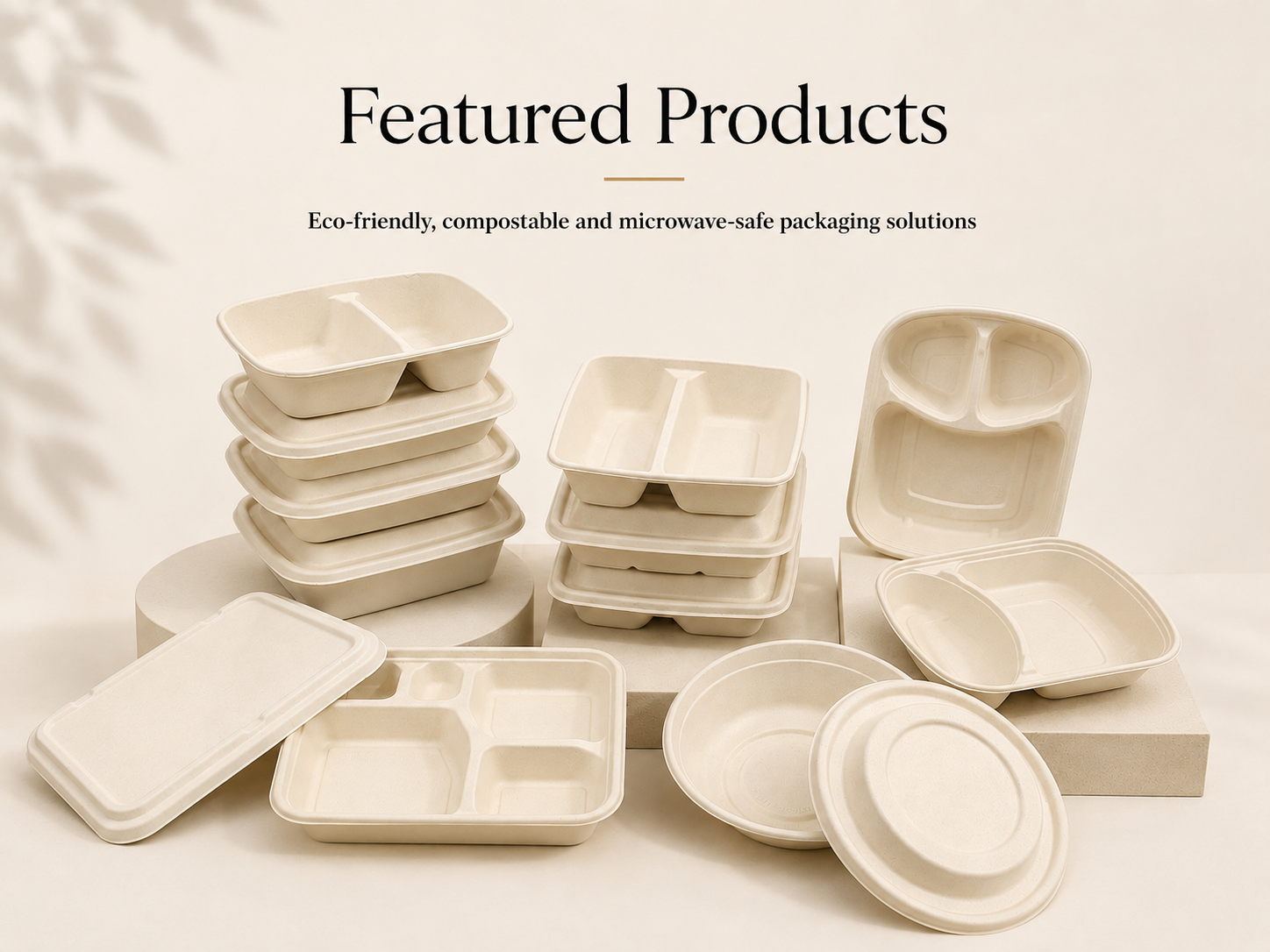
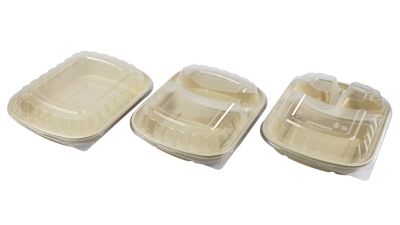
Rectangle-series fiber pulp bento boxes offer a practical format for modern takeaway meals, where clear separation and dependable handling matter. The National Restaurant Association’s 2024 *State of the Restaurant Industry* report found that 47% of adults pick up takeout at least weekly, underscoring the regular demand for convenient meal packaging. Available in one-, two-, and three-compartment layouts, these boxes hold approximately 1,000 ml, giving food-service operators options for everything from rice and steak to curries, Japanese-style bentos, ploughman’s lunches, and saucy burritos. Secure PP lids help keep meals covered during transport, while the compartment choices make it easier to package a single entrée or separate mains and sides.

Packaging choice also matters at scale: the U.S. Environmental Protection Agency’s 2018 materials report recorded 82.2 million tons of containers and packaging in municipal solid waste—28.1% of the total. Fiber-pulp containers provide a distinct material option for food businesses evaluating their packaging mix; the PP lid is a separate component, so operators should check local collection and disposal guidance rather than assume the complete pack is accepted in the same stream. With a generous capacity and configurations suited to varied menus, these bento boxes support organized packing for dine-in leftovers, takeaway, and delivery.

FAQS

What does a Cobb60 result measure?

It measures water absorbed by a molded-fiber surface during a 60-second test. Results are reported in grams per square metre. It is a comparison, not a full performance verdict.

Does low Cobb60 absorption prove grease resistance?

No. Water and grease behave differently. Test oily foods separately, using a defined oil, contact time, and temperature.

Which parts of a container should be checked for leaks or oil stains?

Inspect corners, seams, and the base, where liquid may collect. A smooth base can behave differently from a rough rim.

How can a container be tested under realistic conditions?

Fill it with representative food and hold it for the expected service period. Then check for softening, leaks, and visible oil stains. Warm meals matter.

Why should test conditions be recorded?

Different methods can produce results that are hard to compare. Record conditions and keep procedures consistent. I might still miss a detail.

What affects the compostability of a molded-fiber container?

The complete item matters, including its lining, additives, coatings, and inks. The fiber base alone does not tell the whole story.

What do ASTM D6868 and EN 13432 assess?

They set criteria for compostable packaging, including biodegradation and disintegration. EN 13432 includes a six-month biodegradation period and a 12-week disintegration period.

Does passing a compostability test mean every facility will accept the container?

No. Laboratory testing does not guarantee local acceptance. Check with the local composting facility, and ask whether the results cover the finished container, lid, and seams.

Conclusion

What Factors Affect the Quality of Molded Fiber Food Containers? Quality begins with the pulp itself and how it is formed into useful shapes for meals, takeaway service, and food storage. Fiber type, basis weight, and wall thickness influence rigidity and load capacity, while molding pressure, drying conditions, and tool design affect dimensional accuracy and consistency. A well-made container should maintain its shape without being unnecessarily heavy or difficult to stack.

Performance also depends on resistance to water, grease, and heat. Cobb60 absorption and suitable barrier tests can help assess moisture resistance, while practical checks can evaluate leakage, load-bearing strength, temperature performance, and lid fit. Food-contact materials should be assessed against applicable requirements, including U.S. FDA 21 CFR 176.170 and EU Regulation 1935/2004. Compostability claims should likewise be supported by relevant standards, such as ASTM D6868 and EN 13432. Considering these factors together provides a more balanced basis for comparing container quality.

Alexander

Alexander

Alexander is a dedicated marketing professional at Foshan City Harvest Packaging Co., Ltd., a pivotal manufacturing and service hub nestled in Guangdong Province. With a profound expertise in food packaging solutions, Alexander plays a crucial role in promoting the company's commitment to......
Previous China Top Sugarcane Bagasse Packaging Is It PFAS Free?